
By the time you finish reading this bio, I’m closer to True Mother, and so are you.

  • 0 Posts
  • 27 Comments
Joined 4 months ago
cake
Cake day: May 12th, 2026

help-circle

  • Machine translation is also pre-ChatGPT tech, yet Google have been outsourcing their Translate to their Gemini, as in, Google Translate became yet another Gemini interface, just like many Google “products” nowadays.

    But I’m aware of and I agree that “protoclankers” such as Image Classifier models (e.g. MobileNet) are lightweight enough to run on low-end devices like the one (Nokia 5.4) I use… although, even in this case, when protoclankers are employed in place of clankers, one of my main points stays the same: the steps being performed whenever there’s a (false) positive for a pre-instructed pattern.

    A false positive is particularly likely for protoclankers due to their higher compression. If even full-fledged clankers such as Mistral can misread my owl drawings as “a cat” or (because we’re talking about Google) Google Lens/Gemini can misread my digital art of a solar eclipse silhouetted by a Bubo virginianus as “a viral photo showing a Spanish professional skateboarder Danny León performing a mid-air trick perfectly aligned with the August 12, 2026 total solar eclipse” (when it’s far from being a photo), I can only imagine how awfully a million-parameter Image Classifier protoclanker can perform with deeply-symbolic and carefully-drawn art which even humans can struggle to understand.

    There’s no magic when it comes to how much data can fit within a mathematical representation of a dataset larger than the representation itself, especially when Zipf’s law gets applied to said dataset in order to try and remove hapax legomena while also accounting for repeated data.

    And what happens after a false positive happens? Even if it’s a locally-ran image classifier, the whole thing isn’t fully local; if the locally-running protoclanker detects something matching the pre-instructed pattern, then a set of online tasks will likely be performed: uploading the file(s) to Google servers or, if the pattern being searched for is criminal imagery, preemptively filing a report to the authorities.

    In the latter case, if the protoclanker is filing reports without humans in the loop doing the due-diligence of double-checking (which is very likely what’s happening due to how employees cost money and how Google et al have been prioritizing their budget to the ongoing AI hype), then Google, legally responsible for their protoclanker, would be committing the crime of false accusation (e.g. misreading my derivative mashup between Burney Relief and Éliphas Levi’s Baphomet as “CSAM” as it incorrectly labels the flanking owls as “minors”).

    And given how my artistic content is anything but criminal (the most shady aspects being the psychological horror and the depictions of blood in vampire contexts, aspects of which, given how there are Hollywoodian horror movies depicting the same, are perfectly legal), stemmed from a legitimate religious expression which (at least on paper) is protected by law (Article 5, item VI from Brazilian Federal Constitution as I’m someone under the umbrella of Brazilian laws) and done in a private space, the potentially unsupervised filings of false criminal accusations by Google’s protoclanker, be it against me or any other law-abiding person, will hopefully result in Google shooting themselves in the foot.

    The guerrilla tactic here is me being bold enough not to care about the consequences of using a surveillance device (a phone running stock Android) to register, record and manifest my faith in a very verbose and unfiltered, artistic manner, fully aware that the phone will phone home (pun intended; I don’t even bother to use VPNs and PiHole, I’m raw-doggin their surveillance when I’m not on my Linux laptop); and in the meantime, hoping Google will hoard fragments of my dark psyché to train their Gemini (thus poisoning the well in the process; it would be fun to see Google Search/Gemini, out of nowhere, randomly spitting invocation texts written in Akkadian/Sumerian cuneiform, infodumping owl taxonomy and their diet, spitting random ramblings against the Demiurge, quoting pessimist philosophers such as Phillipp Mainlander, and/or having Nano Banana to produce images with glitched artifacts resembling the Seal of Lilith).


    [email protected]


  • That’s the thing: they’re looking for something, and in order to look for something, they must look, and lots of computation (AI inference) must happen, especially when it involves nonindexed files (my own private art, from digital drawings and handmade sketches, going through photos of my own ritualistic installations, all the way to Blender 3D renders and animations, all of which is yet to be crawled). And if this involves gibibytes of data, on a smartphone whose hardware can barely run 1B parameter clankers locally without hiccuping, I can see my private files going to Google’s servers for “efficient inference”, files of which will likely end up seen by (and sowing some interesting inspirations for nightmares in the subconsciousnesses of) Google’s employees during server maintenance/audits or, mainly, end up training their clanker.

    As for the latter, hopefully Google Gemini would end up “seeing” enough of my digitized psyche to randomly start silly infodumpings about, for example, different owl taxonomies and their diets down to the very gory microdetails about how owls make a tasty dinner out of mice, and/or the different interpretations by historians and archaeologists regarding the figure (Ereshkigal or Lilith) depicted in the Burney Relief, a Mesopotamic plaque of which, by the way, is part of the phone’s gallery too (including my own artistic works inspired on it) and seemingly an efficient trigger for nudity detection algorithms, which will likely put the rest of the gallery under automated scrutiny (because there was a positive, albeit a false one) and, thus, serving as the semantic Trojan Horse for my dark artistic private content to make its way to their servers.

    I mean, how else Google Gemini would’ve taken the “inspiration” to suddenly start telling people to “eat rocks” and “add glue to pizza”? Its training data is crowdsourced so there’s nothing much Google can do to avoid sources poisoning the well (and I must nod at the Nephentes algorithm which I praise as way more efficient than Anubis to hurt the western AI corps) other than:

    1. Adding said poisoned sources to their .gitignore equivalent if they know they’ll likely find poison they don’t want messing up with their expensive AI training.
    2. Doing manual curation of people’s personal files, which is time-consuming and potentially unfeasible when dealing with billions of phones.
    3. Trying to improve the detection algorithms to avoid poisoned sources (which requires training data, which requires them to rely on potentially poisoned sources, which defeats the whole purpose of improving the algorithms in the first place).
    4. Stopping to put everything else into scrutiny when the detection algorithms stumble upon (potentially false) positives, risking false negatives, which will likely attract some heat from regulatory agencies worldwide and fines for failing to comply with things such as age checking laws (and there it goes the GOOG stocks, together with the entirety of NASDAQ, like a Titanic as investors realize they’re paying for fines not theirs; be it GOOG or other stock, the popping of the ongoing AI bubble will inevitably be something in this regard, Western corporations having their clankers failing on them).

    At best, this will consume some portion of Google’s resources (including but not limited to human resources), albeit as infinitesimal as my silly existence can get to a worldwide corporation, but it’s still something I guess…

    [email protected]


  • I once stumbled upon this app automatically installed on the phone I happen to have paid for (because at this point I doubt I could call this piece of metallic tile “my phone” and suing Google Inc. for them to refund me this phone would be as successful as if I tried to push and move a certain Mountain View building from its place with my own muscles). Shortly after that, it seems to have vanished from the list of apps as mysteriously as it initially appeared, either it uninstalled itself or it was changed names.

    In any case, as soon as I realized that presence and realized I wouldn’t have an “uninstall” option without turning on options that would straightforwardly break banking apps and government apps (gov.br the Brazilian app for everything citizen-related) I was compelled to use, I started filling the phone’s gallery with all sorts of potentially-triggering stuff I either find online or (mainly) make myself: dark art including FNAF-like jump scares, haunted/cursed artifacts and occult/ritualistic imagery, photos and videos depicting snakes and scorpions, lots of Memento Mori including photos of cemeteries and tombstones, archaeological skeletons, buzzards eating animal carcasses in the wilderness, as well as media of my own cut wr… I mean, uhm, media of my own cute wrathful owl I sculpted on Blender. Yeah, several different 3d rendered scenes and short animation videos as well, especially scenes in which she’s performing chases and huntings… Not to mention the plethora of owl photos and videos, many of which are birdwatching of them catching and eating prey on nature, in potentially gory settings (i.e. the unfiltered, untamed nature who doesn’t care about our anthropocentric definitions of good and evil).

    So if Google decides to start “protecting me from (my own) sensitive imagery”, their clanker is essentially going to have a hard time having to go through gibibytes of media and potentially wiping the whole device as I made sure to fill the entire storage (even non-media things too, such as using provoking nicknames for fictional contacts like a contact card for “Inanna”, as well as odd descriptions for bank transactions such as “my soul belongs to Ereshkigal”) with purposefully sensitive content. If they do that, I’ll then have something more concrete to sue them for: religious intolerance, as it’s all representing of my left-hand path spirituality.

    And with all this I leave this one absurdist idea on how to try and boycott the corporate nanny (and surveillance). A phone gallery full of sensitive items (not nudes, but dark/provocative art purposefully built to trigger similar nannying responses) will hopefully overwhelm their servers, shall they offload the computing to their data centers. If this doesn’t overwhelm their servers, at least the techbros and their clankers are going to have an interesting time when scrolling through legal-yet-disturbing content they hoarded from Android users’ phones.

    [email protected]


  • Sincerely? I hope not, or at least it must be an opt-in thing rather than something forcefully imbued into the platform.

    Languages that I don’t know may pose a language barrier to me, but at the same time there’s something magic in getting to recognize (and even trying to spell/write) certain words and symbols once I put myself into trying to figure out what’s written and how it’s written.

    This is how I managed to learn (albeit imperfectly and in a fragmented manner) the ideographs I mentioned earlier, among several other languages, including the so-called “dead languages” such as Sumerian and Akkadian (e.g. whenever I see “𒆤”, I know it’s “lil” meaning wind/spirit)… And this is how I learned, to give broader examples, what a “bumat” (البومة) is in Arabic and which letters are involved in its writing, or what’s the difference between a “búho” and a “mochuelo” and a “lechuza” in Spanish, or what a “fukurou” (フクロウ) is in Japanese, or what a “chouette” is in French, or what an “oehoe” is in Dutch (especially how one was able to enfrighten two Dutch villages years ago, the cute yet fierce “terror-oehoe”), or “Eule” in German, or more symbolic words such as “lila” (לילה) “night” in Hebrew or “Лилит” as the Russian transliteration for Hebrew “לילית”… I was able to learn, or at least memorize, a ton of things across languages… Without AI.

    Any kind of automatic translation, especially when AI-powered and fused into the UI, would hardly let me learn a language, because it’d bring the whole thing chewed up and translated, with no means for me to break the sentence down to its constituent words and letters/symbols and how much the surrounding context changes their meanings… not to mention how it ends up wiring our brains to expect the machine to do the reading for us, then we become dependent on machines to do what’s essentially part of being a living being (humans and whatnot).

    Also, translation often involves nuance, tone, sarcasm, emotions. AIs can be able to do “sentiment analysis” and connect words together in order to derive an assessment, but it’ll be devoid of the attempted connection from whoever wrote the text being translated.

    That said, Bilibili does have an automatic translation for titles and comments, turned on by default. I deliberately turned it off, because I want to see the Chinese ideographs, even though I’m not able to truly understand what I’m reading there. I expect to learn them from context and repetition, from trial and error… And when I get to see one of the ideographs standing out before my vision as something I know, getting to see them and yelling “hey, I know these two symbols, these are baxi 巴西 and together they mean Brazil”… Oh, there’s a whole fun to it, a fun that’s virtually non-existent when a clanker is doing all the heavy lifting.

    Don’t get me wrong, I do use translators, I’m not against translators, but I personally prefer using them manually, under my own pace and command while also being able to isolate certain words from surrounding sentences, this way getting to expand my vocabulary a little bit through a research of my own (e.g. looking it up on Wiktionary or other dictionaries out there), because I want to be able to learn something, anything, from it.

    [email protected]


  • As soon as I saw this news, I signed up there in order to see how it is like. I’m yet to find non-Chinese-language content, as I don’t really know Chinese. I mean, I do know from memory some very specific Chinese ideographs (given my special interests) such as maotouying (猫头鹰 lit. “Cat-headed eagle”, which is one of the words for “owl”, aside from xiao 鴞) which was, unsurprisingly, my first search in Bilibili. (I also know words and ideographs such as hong 红 red, ni hao 你好 greetings, ren 人 person/people, among others that wouldn’t suffice for me to, say, buy 500g of bread in a bakery during some trip to China, lol)

    The platform quite of reminds me of xiaohongshu (Red note), including the same emoji pack.

    Then I tried to search for words with Latin alphabet (e.g. “Ereshkigal” and “Pomba-gira”) and the results were nothing directly related to my search query, with Bilibili returning me a list of recommended videos based on my watch history (owl videos) instead.

    One thing I liked is the lack of notifications (TikTok used to push notifications a lot) and the (momentary) lack of advertisements, maybe because there aren’t companies from my geographic region (Brazil) buying ad placement there yet.

    As a Brazilian, I’m sincerely wishing to see more Chinese and nonwestern alternatives to things, including but not limited to video platforms. I’ve been boycotting YouTube for two years and counting, for example, and it would be interesting to see a Chinese alternative to it other than the westernized TikTok (which is nowhere near to Chinese-only Douyin and its likely better/educational content). And, of course, I’m also rooting for PeerTube to gain traction, because it’s native to Fediverse.

    [email protected]


  • - Wait until midnight.
    - Turn on the computer using the foot’s thumb finger.
    - Clean the mouse’s trackball while you hear the Windows XP’s starting song “trunn trun trunnn, trun-trunnnnnnn” in your bedroom, followed by some cracking noise foretelling an incoming cellphone call in your Nokia 3310.
    - Dial the ISP using the Windows XP’s “Dial-up connection” dialog
    - Spin up a Winamp playing the same “Numb” by “Linkin Park” (or “Bring me to life” by Evanescence, or “Fireflies” by Owl City, or several other classics) over and over again.
    - Spin up MSN Messenger and see that “Numb - Linkin Park” (or whatever song) as both your status message and your contacts’ as well.
    - Spin up Internet Explorer 6 and go to Orkut.
    - Oh, a new testimonial and two new scraps.
    - Also a new discussion thread in the community “Eu odeio acordar cedo”.
    - Got tired of Orkut communities, check if there’s anything new in “Buddy Poke” and “Happy Farm”.
    - Got tired of Orkut altogether, but Jake, my colleague from school, just made my MSN window to shook and sent me a Wink, inviting me to a match in Counter Strike. I plug it to the living room’s CRT TV using a convoluted connection.
    - My grandpa starts complaining about how I’m damaging the CRT TV with the pesky Computer-to-TV adapter.

    This won’t be coming back. Like, ever. The Alpha Gen and most of the GenZ will never be able to truly know what I’m taking about.

    So, please MySpace, don’t try to fool me with illusory hopes. Yahoo Messenger isn’t coming back. Limewire and E-mule’s “Every-Linkin-Park-album-ever-released.exe” aren’t, either. And it won’t be MySpace the one to bring that to life (pun intended). Since Harambe died, the world has never been the same. In the end, it doesn’t even matter.

    [email protected]


  • Those aren’t paywalls.

    Why?

    The concept of “paying for something” isn’t limited to “paying with fiat money/currency”. One can “pay for something” by “paying with their attention/time”, one can “pay for something” by “paying with PII” (personally-identifiable information), both situations of which are present in both Reddit’s and Meta’s “Sign up to read this”.

    Sure, Reddit and Instagram/Facebook are “free” insofar the user isn’t required to do any kind of bank/credit card/cash/cryptocurrency payment, but the user ends up paying with all the time they spend in these platforms while seeing (thus, giving part of their attention span) advertisement, and also hand personal data.

    When it comes to PII, even if the user set up a pseudonym and a generic PFP, the user is still handing, even if unbeknownst to the user themselves, their preferences, opinions, etc. Even lurkers end up handing PII whenever they stop at certain posts to read/see it (thus, signaling one’s preferences) or use specific search queries (again, signaling one’s preference).

    That’s not what a VPN or incognito modes do.

    The incognito mode may not prevent tracking (especially because of the IP address), but rotating VPNs may do. Notice I used the word “may”, not “will do”, because of the behavioral tracking I mentioned earlier, as well as other technical aspects (DNS leaking, browser fingerprinting, etc).

    People who can afford being an actor/actress and performing very convincing alt-personas behind a VPN IP address could theoretically fool platforms enough for the person not to be tracked by their gait… except this dramaturgical skill is a behavioral tell (gait) itself. And the usage of a VPN-assigned IP address is another tell.

    [email protected]


  • Yes, but the phrasing used by Codeberg, “Content that harms the reputation of Codeberg, such as cryptocurrency related projects”, is dangerously vague. One could argue Anubis is “cryptocurrency related” insofar it uses a cryptohashing technology also used by cryptocurrencies. Blame the “related” word in their phrase, a word of which is allowing for this kind of interpretation.

    And while I didn’t watch the video you sent me (because I’ve been actively boycotting the monopolistic platform “Youtube”), I’m well aware of how crypto world is full of scam and I guess I fully agree in this specific point of yours (“cryptos are more often a scam than not”).

    [email protected]


  • now I have to somehow veryify a PR isn’t vibe-coded in addition to everyþing else lest I get a ban hammer?

    Yeah, I’d say it’s one of the risks you’re facing from now on, from accepting PR to your repos (and you’d better stop accepting PRs altogether at this point). However, I’d also say it goes beyond merged code from PRs. Because it’s sometimes near-impossible to tell human-curated AI-generated code and human-made code apart, anything, at any point, can be accused of being AI-generated, and this rule is likely going to be retroactive (i.e. old but post-2021 repositories are as subject to this decision as the newer ones).

    þis is my concern. I don’t use LLM, and most of my projects by now contain a “please don’t submit vibe-coded PRs”

    Although I have a few old repos (mostly code-golfing, steganography and demoscenes/procedural esoteric art) I had backed-up from a former GitHub account, my worries are less about my code hosted in Codeberg (code of which is kind of abandoned at this point so I don’t truly care about my own repositories at all) and more about how it’s part of a bigger situation in which heavy-handed moderation mechanisms could be weaponized by people targeting works/artworks and/or creators/artists against which/whom the former people got a strife.

    In this sense, even the Anti-AI people cheering this decision could, as ironically as it may sound, become the accused ones themselves, as anybody’s contents can be accused/reported/flagged of being AI-generated, just like a cop can plant fake criminal evidence inside someone’s backpack and cry “criminal”, then the burden of proof will befall over the owner of the backpack who’ll likely have no means of explaining themselves.

    If I used Codeberg, and I paid for it, I’d have a beef wiþ þe ban. As a free service?

    At least IMHO, while Codeberg is indeed a “free service” and not something that could be refunded, being a free service isn’t exactly a blank cheque: platforms such as Google, Facebook, TikTok and Xitter, even ChatGPT and the alike, for example, are all “free” services as well, could these platforms do anything as they please?

    [email protected]


  • I cannot guarantee that there will never be any LLM use in the future

    Even if there’s no AI-generated code in a repo, there’s something else to this entire situation to which people seem to be completely oblivious. It’s how human code can be mislabeled/reported/accused of being “AI-generated”.

    And, then, all of a sudden, the burden of proof will befall onto the accused, possibly without means of recourse. Any mislabeling would require the accused to prove the human authorship.

    Oh, and any proof could be counter-argued to have been “AI-generated” as well… Because, as it turns out, It’s not as if people recorded themselves from a third-person perspective like they were a character in a damn game while they coded with their flesh-and-bones hands, and even if they did, anyone could argue “it’s AI-generated video, nobody records themselves in a third-person perspective”.

    [email protected]


  • Anubis, tho the transaction is so quick I can’t 100% confirm that, but I think they do

    The amount of time which Anubis and other PoW-based algorithms take to solve a cryptographic challenge will depend on several factors, namely: the challenge level (depending on the webmaster’s settings, the level can be increased if site traffic has increased), the CPU clock speed and amount of CPU resources available for your browser (and, by extension, for Anubis’ ServiceWorkers), as well as… luck. It’s dealing with randomness, after all.

    retro-fitted two pretty powerful, not your standard, fans in the old PC to mitigate some of that heat, along with the stock fans that I used to build it

    Not to mention how a desktop CPU, even when old (and especially when old, as it likely means a standard big ATX rather than a mini-ITX), has lots of surface area to dissipate heat, and a metal PC case built for radiating the heat away while allowing for better internal circulation of air (contrasted with the non-conductive plastic case from cheap laptops such as the one I own).

    Whereas your laptop generally utilizes one fan

    Yeah. And in my case it’s a very inefficient, old fan. One that makes louder noise (akin to a car engine idling or cranking) as soon as it gets faster trying to keep up with the CPU heat… Oh, and I forgot to mention this in my previous replies: I also know when my CPU temps raised because the cooling fan becomes more noisy.

    I don’t know, but it intrigues me so I’ll keep a closer eye on it just out of mild curiosity.

    We often underestimate how much computing power the Web have been demanding from our personal devices. Web browsers have became full-fledged Operating Systems inside whatever Operating System the user uses, and some websites are massive in terms of CPU and RAM requirements. I mean, nowadays we have video editors, graphic suites, 3D suites, even 3D games, running entirely in browser…

    [email protected]


  • however, as someone who watches temps closely on my server and especially on my old PC, I can’t confirm that a site causes a dramatic rise in temps

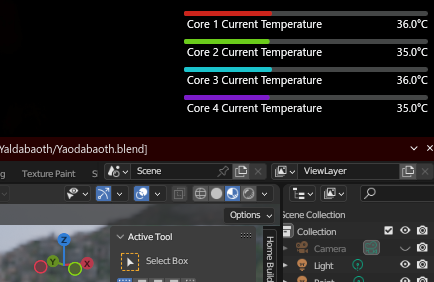
    I use a KDE widget (System Monitor sensor) seen in the screenshot. It’s kept on my primary screen, right next to the clock, so I can watch the CPU temps as closely as possible. I also have a secondary widget at the drawer, displaying the CPU usage, as well as RAM and swap usage.

    Notice, in the screenshot, how I’m running Blender and, yet, my CPU temps are somewhere around 35-40C. Partly because it’s currently winter here in Southern Hemisphere (and it’s quite cozy-cold around here where I reside), partly because it’s just Blender and a couple of lightweight websites opened in Waterfox. Even Catodon, the Misskey-fork platform I use for interacting with the Fediverse, is quite lightweight, especially because I turned off heavy JS animations.

    But this scenario would change if I was faced with a sudden Anubis or Cloudflare. Because I watch the temps and they update each second, I can readily notice the temps increasing as Anubis/Cloudflare do their shenanigans.

    Sometimes I’m browsing the Fediverse while awaiting for Blender to finish the rendering of an animation/scene. The rendering itself doesn’t warm my CPU too much, as I can adjust the thread count for Blender, but SharedWorkers in JS can take as much cores as they want because they can be instantiated multiple times, e.g. one for each CPU core. So, if Blender is opened, the temp increase can be higher, because there would be two simultaneous heavy computations competing for CPU cores. And, as I mentioned in my previous reply, the situation gets more dangerous during summer (although I avoid putting my laptop into heavy computing situations during summer).

    [email protected]

    Screenshot of my KDE desktop showing the temp widget above a Blender window.


  • is there a reason people dont like cloudflare

    I hate Cloudflare especially because it’s slowly becoming a monopoly (if it didn’t become already). Webmasters are giving too much power to a single corporation to rule over who can access online content and who can’t. Old browsers and privacy-oriented browsers (e.g. Librewolf) are known to be more likely to be refused by Cloudflare, and this is a form of prejudice.

    Also, and bringing Anubis to the loop too, there’s the lack of user consent. As a guest/user, I’m unable to consent with the heavy computations (and potential damage to my decade-old laptop from overheating) before these happen.

    What I mean about “lack of consent” can be better illustrated by the “This site uses cookies” message: it often offers buttons so the user/guest can choose to either “accept” or “reject”. Have you wondered why every website must give these options nowadays? Because it’s a literal law. Neither Cloudflare nor Anubis have a “we’ll need to validate your browser, do you consent? Proceed with verification / Leave the website”. Something tells me Cloudflare, and Anubis as well, are literally illegal pieces of code in European Union, given the lack of user consent, although this wasn’t tested in courts yet. I’m not European (I’m Brazilian), but it would be quite entertaining to see this tested on an European court.

    Finally, these things can cause literal harm to a device. Yes, because when any kind of computation happens, the CPU gets a little warm, and when said computations involve cryptomining-like behavior, CPU temps can raise a lot. And for devices such as mine, an i5-7200U laptop whose fan isn’t good (and I can’t afford a new one), the CPU can easily get to 90C, to the point of damage, if the computations take long enough. Given a PoW relies on randomness, there’s a literal chance that a challenge would kill my laptop if it took several seconds during a Brazilian summer (>42C almost wet-bulb). And I doubt the webmaster would be liable for the material damage their website caused to my personal device, so I’ve been speedrunning my way to close websites as soon as I see “Just a moment” or “Making sure you’re not a bot” as their title, I even made myself an userscript for doing so.

    [email protected]