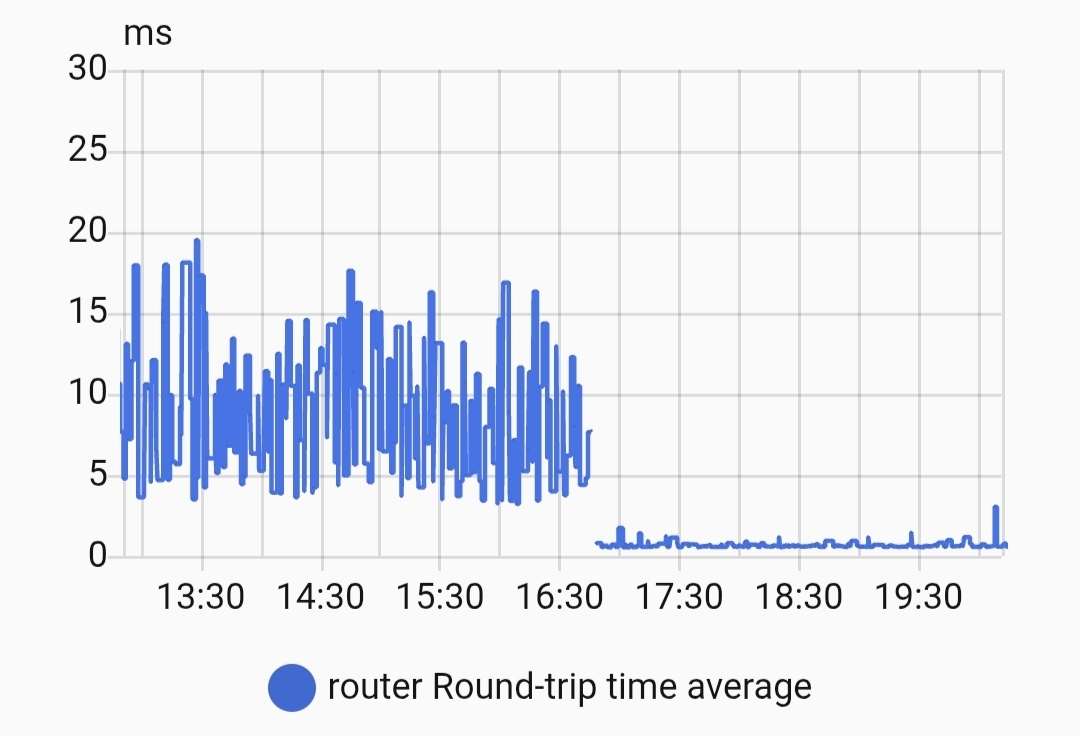

Homeplugs (ethernet over power) are fine for some things, but they add so much latency to the network.
Wired is so much better.
I’ve heard of power over Ethernet (PoE for IP cams) but not Ethernet over power.
Yup, there is also Ethernet over coaxial cable TV.
It’s kinda niche, especially with improvements in WiFi over the years.
I thought HDMI to Ethernet to HDMI was cool the first time we had to do it for a project in a large room. Hdmi starts running into issues at around 25-50ft. You can go a lot further with the Ethernet cable
you’re referring to the POE (Power over Ethernet) plugs?
I never knew they would cause such problems, maybe it was just that specific brand?
Powerline communication uses adapters to transmit network signals over existing electrical wiring, avoiding the need for new CAT6 cables and offering a hardwired internet connection in hard-to-reach areas where running Ethernet is difficult or impossible (or where the house owner simply is too lazy).
Yep, too lazy to run ethernet
I think they mean powerline adapters
Yes powerline, they were called homeplugs at 1 point
Still are, but I guess a lot of people don’t know much about them
Not POE, the opposite. Ethernet over power, powerline?
They were called homeplug at 1 point
Those plugs were awful for me. I replaced them with a wifi extender and it changed my life.
Not surprised, as we were getting higher speeds the Ethernet wire also was upgraded. The electrical wires were never set up with data transfer in mind + you might get additional interferences from other devices plugged in.
So it probably needs to retransmit packets frequently.
This post is missing some key information. What’s the network topology before and after? Presumably not just unplugging a pair of powerline adapters.
Ok, switch in the shed/office into switch in the garage, switch in the garage into powerline to switch by the router.
Run cable from the garage to the switch by the router and remove 1 of 3 powerline plugs, so yeah just removing a single plug helps so much
The only thing they are good at doing is producing loads of RFI and pissing off every ham radio operator in the area.
One of the best no-noise locations I ever did was in a fully powered-down sailboat in the southern lagoon at Fort Jefferson, Dry Tortugas. Leaky consumer electronics are the worst.
To contrast, I managed to work Indonesia from Alamogordo NM despite being in a residential neighborhood, HVAC capacitors and foreign over-the-horizon-radar (OTHR) be damned. Taught me a lot about being patient and picking out transmissions in the noise.
Do not send data over power lines.
Do not send power over data lines.
POE is fine… it’s been fine for a long time.
Active POE is fine. Passive POE is an accident waiting to happen when someone inevitably plugs it into the wrong device.
True, but most people who mess with POE aren’t in the habit of just randomly plugging shit into switches, and those who aren’t don’t touch it anyways cause…scary.
Eh, I’ve broken laptop ethernet ports by accidentally plugging in passive POE into it. It happens if you’re an unfortunate soul who needs to debug those devices.
Fair enough
So - PoE = bad? Otherwise not sure what real-world scenario your second case covers?
one where i mess up the breadboard and fry my cables/ microcontroller i guess
Yeah don’t do that one
To be fair, there are some less-than-optimal PoE implementations like “passive PoE”. I’ve heard stories where the wrong PoE mode destroyed network gear.
Yeah, active PoE is the only kind worth buying. Passive PoE is an accident waiting to happen.
I don’t see anything wrong with Power over Ethernet, as long as it follows the standards.
EoP, not PoE. Two different things.
Do not send power over data lines.
Literally the 2nd sentence. “power over data lines” is PoE, not EoP.
Lol I definitely read the same thing twice. Assumed they were just repeating for emphasis. You’re right, my bad.
I once replaced a cheap pair of adapters with a more expensive pair. Was night and day for my network stability. I know it’s hit or miss, depending on your wiring and location. But the adapters themselves can differ.
What’s the ping? Max time to reach any device?
I use it to get to my basement of a multi story dwelling I rent in. From 3rd floor to basement is such a lifesaver
ping times have gone from 2ms and up to under 1ms, but thats how I got into them was to get internet from ground floor to second floor
ping is a tool/protocol-function to measure round trip time. one computer sends out the ping, the recipient replies with a pong, and the initiator outputs the time it took from sending out the request to getting the response. it works on most destinations (just open a commandline and “ping google.com”) so it’s not max time, but actual measured time for a single roundtrip. as processing time is minimal this is considered to be the network-latency.
The users reading this post that think you are referring to PoE are innocence and pure.
Behold. Power line communication https://en.m.wikipedia.org/wiki/Power-line_communication
Yeah, I was so confused for a few seconds, then I realized what they are talking about.
TIL
Somaetimes gaining knowledge doesn’t improve your life.
EoP - Ethernet over Power
I mean does anyone go for power line adapters as their first choice when straight up ethernet is an option?
The number of people that are anti wires, but also want WiFi signals everywhere is too high.
Powerline is so leaky it is basically wireless with wires. 14x3 is not a transmission line, but it does effectively turn your whole home electrical system into both a transmitting and receiving antenna that just happens to talk to it’s self. It’s an engineering nightmare.
I use them to extend my network from my 3rd story apartment to my garage. Wireless doesn’t reach, pulling a cable would be very difficult and expensive.
Yeah there are use cases
I want wires everywhere I don’t care fuck wireless signals give me wired headphones, controllers, networks
Me and my homies hate antennas
i like the idea of wired headphones, but in practice they’re kind of annoying
I imagine your home looking like the set of a Terry Gilliam film lol
… and punctuation, apparently.
I would not, but we had a working system so moving things about should have been fine. I think running over 2 consumer units adds to the latency
Me, i’m still sorting the basement before i run RJ through it
In much of the world most houses will have existing electrical wiring but no network cabling.
Sure, but then the question is “can you install network cabling?” If yes, then do that. Even without the interference bit, power line adapters are so finicky and unreliable that they shouldn’t really be your go-to solution anyway
I think that the answer to “can you install network cabling” is mostly “no”. That’s why mesh networks are so popular these days.
Yeah but between power line and ethernet, it’s not a 1:1 comparison. If you can have ethernet you’ll likely install ethernet. Power line fills a need for ethernet-like internet when you can’t wire the place up.
Yes, we all know that. That’s what we’re telling you. Nobody is installing power line if running Ethernet is simple.
You seem to be expressing shock that people would choose powerline adapters as their first choice. People are replying to tell you that it’s not their first choice, but they chose it anyway because running Ethernet is often way too difficult.
Nobody is installing power line if running Ethernet is simple.
Not sure why you’re adding any more, you’re literally agreeing with my comment, but sure, act like my comment was about future replies, and not the op.
Read the thread, and then ask yourself the question you just asked me.
Powerline adapters are almost always a “last resort” option.
I did switch from homeplugs to mesh wifi. The difference night and day. Less latency, faster and overall more stable.
I arrived at that conclusion because my servers were using a NAs as storage for most services, all of them separated by homeplugs.
When I relocated the NAS with the servers, everything went smoothly so yeah. Removed all of that and used mesh wifi instead (because the line for internet isn’t in the same room as the servers)
You can send stuff through the home power sockets? WTF first time I heard this sounds like magic
It’s old magic too and in a pinch it works reasonably well.
We use this as a networking option for an old dorm I was in which didn’t have ethernet and the concrete walls between rooms made Wi-Fi unusable.
Blocks of rooms were not separated on different circuits which made this possible
Was it not possible to draw Ethernet, or did they just want the cheapest solution? I consulted for a place that had a similar situation, and it was unacceptable for most of the students due to the jitter. So we drew Ethernet and put mini APs in each room.
It’s always possible, but not often practical, especially when you don’t have permission to drill holes in those concrete walls.
I suppose you could do surface runs, but those are ugly and more vulnerable to physical damage.
But I wasn’t facility. I was a student.
The dorm itself did not have internet and had no plans of running ethernet or providing internet to students.
I got internet through a wireless access point, positioned very carefully in window for a WISP. And they distributed that to rooms near me.
I live in a house designed by a boomer. Networking comes in the upper floor while nothing is in the lower
These power over Ethernet is the only way I can get networking down stairs.
Removed by mod
I used to use Homeplug to get network from my router front downstairs of the house to the my office upstairs and back. It’s a small house, and I thought the homeplug was ok - I was getting about 150-200mbps of my 900mbps; not great but I thought it was a good as I could get. The electrics are about 10 years old but I could see there was a lot of noise and error correction when I looked at the software that came with the plugs. Simple direct wifi connection was atrocious as the walls are largely solid brick.
Then a couple of years later I read about how good they Mesh systems could be so I decided to try a cheap one. I was skeptical as wifi hadn’t worked for me. I got a Google Wifi system (not a fan of google but it was a cheap system compared to other mesh networks); it has no backhaul connection, just 3 wifi points (one in front room, one in hallway and one in office), and my speed jumped to 500mbps and low latency. I also hadn’t realised how bad the latency had been on my homeplug set up - it was night and day.
I have since upgraded to an ASUS XT8 system; 2 units only and I now get close to 800mbps on a good day, and 600-700mbps floor. My PC in my office is where I work (which involves high data transfers) and also game and chill, it’s been a huge boon.
So yeah, Homeplug does the job but it’s not great in my experience. It was cheap compared to a mesh network, but you get what you pay for. You can get some of the cheaper and older mesh systems 2nd hand on ebay - but unfortunately a good system is pricey. In my experience it was totally worth it.
I don’t mean to alarm you, but networking was designed by boomers.
😱
I love my EoP but yes, it’s a big noisy bus. Ok for small checkins and pings etc. like wifi every device on the bus takes a time slot away from another. I do want to see what my electrical upgrade from old wires to thicker gauge inside of grounded EMT does for it though.
Homeplug is a defunct standard that had some real limitations, Ethernet over Power is a generic term relates to any standard of network over power lines.
The G.hn powerline standard is a massive improvement (despite being almost as old and is closer to MoCA as it will actually work over coax and other copper wiring, not just power lines) for both performance and stability, but the Homeplug standards have probably ruined the public perception.
G.hn is also a bit weird because the Wikipedia page presents it as how carriers could use, not as a home network option, even though a few home pieces of equipment are available, such as the TP-Link Deco PX50 which uses G.hn for the wifi backhaul.