
Honestly the damage is done. Manjaro has been an instant no from me dog for a long time. The name carries a negative connotation. Trust has eroded.
What happened?
The trust. It eroded.
I mean, I think they were looking for a little more detail that that.
Over a hundred thousand years the ocean of distrust has eroded the cliffs of trust in a non-insignificant manner.
Keep the dumbass reddit style “jokes” to reddit. Either answer the question or stfu. You’re not funny and your lame attempt at a “joke” is just annoying.
You know what I am going to do it even harder dot gif
There shall be no mirth in this place!
It’s not mirthful, it’s dreary and tedious.
I think your butt plug has gone sour. Time to change it.
And yet their “unfunny lame attempt at a joke” got 90+ upvotes, so clearly some people thought it was funny.
I don’t see anything in the rules that says you can’t make a joke in the comments. The only thing that comes close is rule 7, and even that allows comments. Maybe you should go back to reddit?
If you’re bringing the rules into this conversation, you’re misunderstanding the conversation
from what i undertand, everyone else is making jokes and enjoying them while one person has to be a debbie downer
Hah, sure, I’ll cop to that, you’re the downer for bringing up the rules lol
So mean for no reason.
Plenty of things, but the most obvious being the two separate instances they had issues with renewing their certs.
It’s more than that. Broken updates. Failed hardware ventures. The project has been shambling along for a long time.
and the certs lapsed again after volunteers built tooling to Prevent That
but somebody never set up the cron job to run it
Well that’s confidence inspiring.
Don’t forget their package manageer DDoSing the AUR multiple times
Oh yeah. Forgot about that one.
You seem to have misspelled package mangler
I liked Manjaro, they had a nice theme, it was in the direction of Arch, but still had some guardrails for the noobish.
Then my system kept breaking, then they screwed up their certs. If they want to fork it and go forward with a different focus/ideology, that’s fine by me.
Could you please explain why not renewing their certs is such a serious betrayal? Like, if they fixed it, isn’t that okay? And even if it happened again, and they fixed it again, isn’t it human to err? Or why is it such a harsh offense?
Serious question, I don’t know the consequences of not renewing these certs. 😊
It’s the tls certificate that proves your website is legit. Without which, you can potentially be a malicious actor that can pose as the website, and when you download the iso, you could unknowingly download something malicious. It’s pretty hard to forget certificate renewal (most of the time there are plenty of reminders sent and warnings given), so the fact that it happened twice was very impressively bad.
It’s pretty hard to forget certificate renewal (most of the time there are plenty of reminders sent and warnings given)
Oh boy. Seems to be the opposite in real life. Especially when it comes to managing stored cert of businesses partners. It has gotten somewhat better now of course, but three years ago most of my company’s sev1 production issues were due to lapsing or unscheduled cert changes.
Can confirm it happens often here too indeed.
it’s the main way for software to verify the identity of a source. without it you let nefarious actors do something like hijack a DNS server and impersonate your servers to your users, which is a pretty big problem if you’re running a software distribution network! it is literally a breach of trust and massive security vulnerability. and it probably broke a ton of shit when software that uses the certificate found an expired one and suddenly (and correctly) refused to work.
People are very harsh with Manjaro. There’s more than just a list of objective facts unfortunately. I suppose there were some bruised egos at some point.
The certs issue wasn’t a big deal, it didn’t change anything for me as a user. It just paints a bad image.
As a former Manjaro user, it has some issues. It has weird bugs that aren’t present in any other Arch-based distro. Pamac ddosing the AUR is pretty bad as well. I’m thankful I used it as long as I did though. It got me hooked on Arch based distros. Everything else feels antiquated now. Actually, Void Linux is kinda cool
Its not just the fact that certs expired, it’s them advising people to bypass warnings or change their system time and how many times they’ve had the issue.
I think it’s actually 3 now. IIRC they did it again last year
deleted by creator
Failing to renew TLS certificates on time multiple times is enough to never touch it again, but there’s also been a lot of other problems with Manjaro.
When I used Manjaro, it never made it more than 6 weeks before something would catastrophically break and I’d have to roll back using snapshots.
The manifesto mentions this and that tooling had been made by volunteers but leadership ignored or rejected it (wasn’t clear which). So it seems that they are firing their leadership for the same reasons you want to stay away, which is a good sign, at least. Like promising that they are willing to mutiny to stop the enshitification.
Yeah the last time I tried manjaro years ago it kept breaking but I thought that was just the linux experience at the time haha
+1
Good for them! A second TLS problem after what happened last time is unacceptable. I hope the ‘mutiny’ succeeds.
Pretty sure this wasn’t the second
And even that was only the most visible yet surface level one of their problems.
It wasn’t.
Just fork already. EndeavourOS exists, an awesome distro, so this threat is a triviality.
If I were a Manjaro dev, I would just jump ship to EndeavourOS, Cachy, or Garuda.
No. Let Manjaro die. It has no reason to exist in any form. Go contribute to something useful.
Except that I want the same release cycle as Manjaro. The only equivalent I have found so far seems to be OpenSuse Slowroll, in beta for the past 2 years.
Picking Manjaro for stability 🤣 that’s a new one.
I’ve never regretted it for the past 7 years on my daily drivers. That’s why I don’t get the constant criticism around this distribution.
Philip can’t operate letsencrypt. And he’s kinda just a shitty neckbeard. Try debian.
I love Debian. Debian is king, Debian is life! However on my desktop I prefer a semi-rolling release distribution.
If you have 8+ cores there’s always Gentoo 😇
I’m too old for that. I’m running a fairly recent laptop - 4 years old. It’s not a beast but largely enough for my usage. Not enough for Gentoo though!
If I may, would you seriously consider switching to openSUSE Slowroll if Manjaro’s situation doesn’t improve? Or, are there reasons beyond its beta status that hold you back?
I used to hop distributions in my youth, between 2000 and 2019. I have settled on Manjaro and never looked back.
As of today, my desktop works perfectly and I have not seen any stability issues.I am considering testing openSUSE Slowroll in the coming months but not on my main computer. What’s holding me back is that I can’t see any momentum behind Slowroll. I have no clue if the solution will be supported for a long period. I’d like to have more guarantees than what is on openSUSE website.
Great answer. Thank you!
I hope openSUSE will eventually get around and enjoy some much deserved momentum. I feel it isn’t quite reaching its full potential as a project, because it (somehow) fails to attract a bigger audience. Don’t get me wrong, it’s definitely doing well and it holds its own admirably. But, (going off of ProtonDB’s data) where Fedora (together with its derivatives) managed to effectively increase its market share by at least 400%, openSUSE[1] -despite Tumbleweed making more sense for gaming- was only able to keep what it had…
It’s the green colored bar found right under Manjaro ↩︎
I don’t think openSUSE markets itself properly. I can’t believe EU_OS picked Fedora instead. That makes 0 sense.
I (mostly) agree. I believe that
bootcmight have played a role in EU_OS’ decision to pick Fedora over openSUSE. Back then, it wasn’t possible to use it outside of Fedora’s ecosystem. But Bootcrew has since released bootc images for other distros; including openSUSE. So hopefully they will reconsider it.
The fact that CachyOS more or less successfully replaced Manjaro’s purpose I guess is evidence of Manjaro’s issues.
I forgot but I think Bazzite had similar complaints (due to its use of silverblue) in which case it was just more straightforward to use Fedora or OpenSUSE if you don’t want to work with the read only root system.
Downstream distros need to bring additional value to the table to be worth using, otherwise there’s really no need if you can make a package group that accomplishes the same thing in one go.
I had been using Pop-os for about a year but wasn’t completely happy with it. A friend suggested Bazzite and, to me, it was a lot better in some ways and worse in others. I’ve since switched to Fedora and don’t really have any complaints. I don’t plan on switching again baring something I don’t see coming.
Is Kalpa still kickin?
Just quit and move to CatchyOS
Distros? Gotta catch them all.
Damn what a catchy name snaps fingers
I don’t game on my laptop, so the benefits of CachyOS over my EndeavourOS are moot.
Aragorn writes that Philip Müller (the project lead) has been running Manjaro as his own personal venture rather than a community effort, keeping a tight hold on access to both the codebase and the infrastructure.
These weasels never care about the actual thing that is being built, its just a way to make money for them.
Hope they kick that Philip guy out and get back to making this a passion project.
The core members with passion for the actual thing should restart under a new name.
As others suggest, why stay attached to Manjaro at all? Instead of forking, what about expending that energy on a rising distro without such reputational damage?
CachyOS is very close “in spirit” if they want to develop modified/custom packages, but there are plenty Arch downstream distros with less toxic communities.
They could even fork some other project and make the changes they like. It’d be a saner base than Manjaro at this point.
EndeavorOS too, which is even closer to “vanilla” Arch than CachyOS.
You are assuming that the cachy devs want the help of folks who have not demonstrated competence in their own project or want to do stuff how manjaro does
I started using Manjaro long before all this crap started going down, and I’ve been holding on hoping this all gets sorted because I hate distto hopping.
But sadly I don’t think its going to happen. I’ve got a new PSU coming to fix a burnt out one that has left my desktop turned off and unupdated for two months. Might be time for an install of something new rather than updating afterwards.
It’s indeed the time. I found Cachy was a good pivot, similar feel but seems to work better overall. Manjaro is still based on Arch after all, technically.
I also started with Manjaro, but it’s broken mess. I moved to Garuda and it has been completely solid and stable for over a year.
Garuda is pretty great if you want a nice experience out of the box. Can recommend.
I moved to endeavour. With the same de it feels very similar.
A significant portion of the Manjaro team has signed a manifesto demanding the project split from its parent company and restructure as a non-profit.
Sourav Rudra 18 Mar 2026
Manjaro has long been one of the more popular Arch-based Linux distributions, known for making Arch Linux more accessible to everyday users. But it has been losing ground for years, both in terms of user trust and active contributors, and the complaints about its direction have only gotten louder.
Now, things have hit a breaking point, with calls for a fork if the current leadership does not budge.
A Manjaro team member going by the handle “Aragorn” has published the “Manjaro 2.0 Manifesto” on the official Manjaro forum. The post lays out a detailed restructuring plan for the project that has been signed by 19 team members, including developers, community managers, moderators, and the company’s technical lead.
Is there any weight behind this?
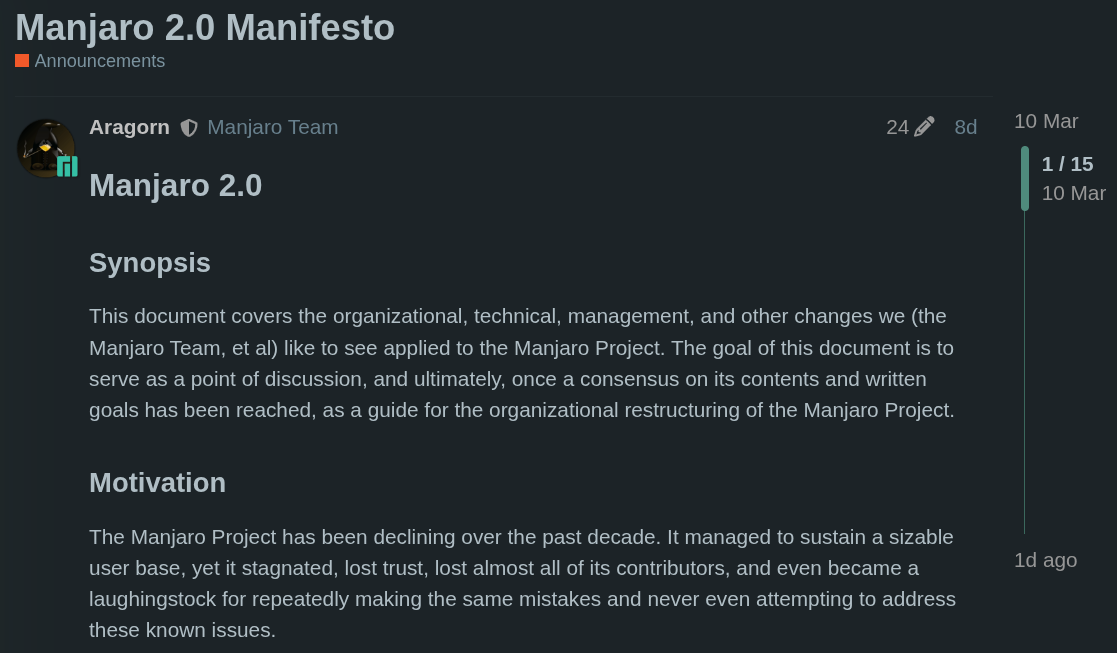 The manifesto opens by stating that the Manjaro Project has been declining over the past decade, losing trust and contributors while repeating the same mistakes without ever addressing them.
One example cited is the repeated failure to keep TLS certificates current, something volunteers had reportedly already built tooling to fix, only to be ignored.
From there, it goes after the core issue directly. Aragorn writes that Philip Müller (the project lead) has been running Manjaro as his own personal venture rather than a community effort, keeping a tight hold on access to both the codebase and the infrastructure.
Aragorn goes on to say that:
The priorities of the Project leadership do not align with those of the developers and community. The current leadership’s goal is to turn Manjaro into a successful business, and thus far, these attempts have mostly failed.
The money situation makes it worse. The manifesto says the company, Manjaro GmbH & Co KG, has not been funneling any of its funds back into the project and has not pursued outside funding either. **What the team wants is a clean separation, where the Manjaro Project is spun off from Manjaro GmbH & Co. KG and restructured as a registered nonprofit association under German law (e.V.).
The new structure would distribute ownership equally among members, use transparent voting for major decisions, and assign “arbiter” roles to experienced contributors for specific domains.
Under the proposal, the nonprofit would get full use of the Manjaro trademark through 2029. The company keeps the right to use it too, as long as the two don’t step on each other’s toes. After that initial period, the manifesto nudges the company to declare that it is willing to hand over full trademark ownership to the nonprofit for €1.
Key assets like the GitHub organizations, the self-hosted GitLab instance, forum, CDN, and the manjaro.org domain would all move over to the non-profit as well. **The team has also laid out what would happen if they were ignored. The “Our Resolve” section of the manifesto says that there are three stages (from 0-2): waiting for a reply, striking and going public, and finally forking or leaving. Within Stage 1, there are three phases that control how public the document gets.
They skipped Phase 2 and jumped straight to Phase 3 a few days ago, moving the manifesto to the public Announcements section of the forum and archiving the thread on archive.org. If things don’t improve, then a forum lockdown is on the table. **Don’t think that this is some kind of witch hunt. One of the Manjaro team members, Dennis ten Hoove, has clarified that the goal of this initiative is not to kick people off the project but to change the leadership and help foster Manjaro as a healthy community-driven project.
Expect a bumpy transition
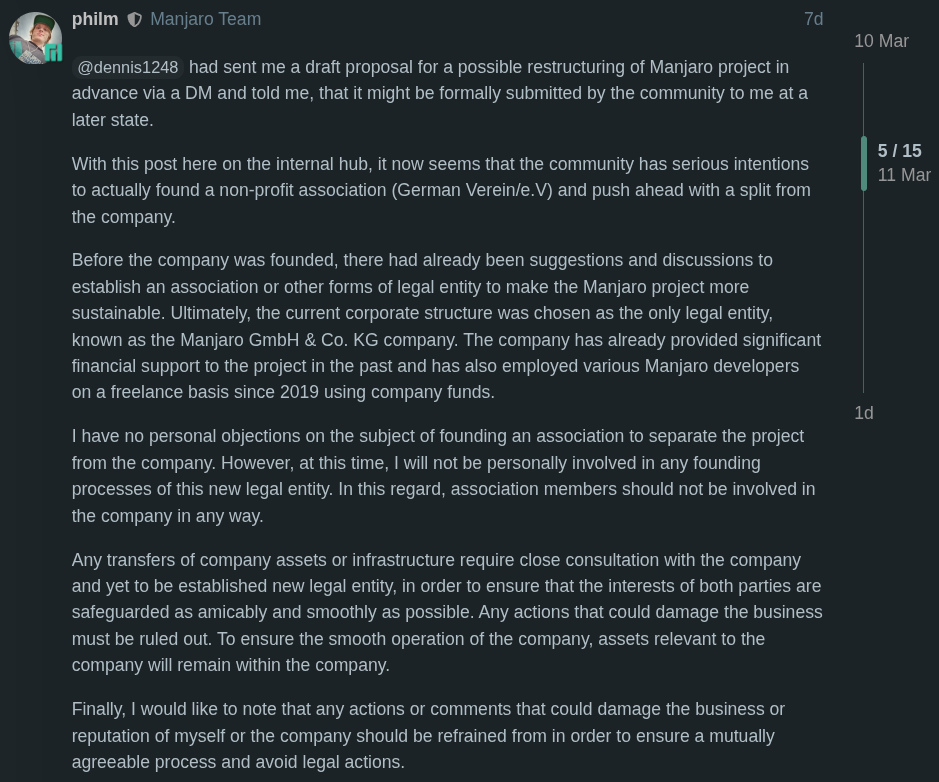 Philip did break his silence on the matter, saying that he is fine with an association being formed but wants no part in setting one up himself. He also made clear that handing over any assets would need to happen on the company’s terms and closed with a warning that public statements damaging to either himself or the business could have legal consequences.
The protesting team’s response was measured, where Aragorn pushed back, pointing out that the manifesto already lets the company continue using the infrastructure for as long as it needs to move its operations elsewhere.
Roman Gilg, who signed the manifesto despite being the company’s CTO, put a direct question to Philip, asking whether he had any specific objection to the list of assets outlined in the document. Philip went quiet again.
After days of silence on that question, Aragorn declared that Philip was stalling and announced the team was skipping Phase 2 and moving straight to Phase 3 (where things stand as of now).
What can you do?
There’s an active community discussion thread with over 200 replies, started specifically to accommodate talks surrounding the manifesto. If you have thoughts on what’s going wrong with the Manjaro project and what could be done better, you can head over and weigh in.
One of the Manjaro old timers, Stefano Capitani, has recently posted there, sharing his view of the situation:
I have to apologize to all of you. It seems I’ve missed some of the events here. I believe, without fear of contradiction, that I, along with @guinux , @oberon , and of course @philm, am one of the “old timers” still active, if not as much as before, but still active in Manjaro.
I have to be honest, I feel like I’m having flashbacks because we’ve already had these discussions or “storms” in the past. We’ve always come out stronger, and we’ll come out stronger this time too.
PS: You need to be logged in to the Manjaro forum to view user profiles.
The new structure would distribute ownership equally among members, use transparent voting for major decisions, and assign “arbiter” roles to experienced contributors for specific domains

Thank you for writing this up, as someone not familiar with what’s going on over there I really appreciate you taking the time.
Thanks, but I didn’t write anything – I just copy pasted the linked article – maybe it is not what the website would want, but I much prefer reading the article in the comments vs having to click the link to read the article.
Raises an interesting philosophical and operational point about how content online should be paid for.
deleted by creator
Just let it die. So much time and energy wasted
gaurda is what manjaro should have been. its perfect for noobs with snapper in grub ootb.
i also like envdeavor anc cachy too
Garuda and EndeavourOS btw.
Huh, that’s too bad. I used it for years to get comfortable with an rolling release arch distro. I thought it was good, but it would break from time to time. Thankfully, Arch is easy to install and maintain these days.
Manjaro was quite messy last time I tried it a couple of years ago.
Switching distros was not on my agenda. 🙃
Me neither. The more I dwell on it, the grumpier I’m getting. Distro hopping is a young man’s sport. I’ve got work to do.
Thankfully, I learned the hard way a long time ago that my files are almost entirely on a secondary drive and my home folders are all simply symlinks to folders there, so I won’t lose any data since that drive won’t be wiped. But it’s just such a pain in the butt to set up everything the way I like it.
Gnome has a Save Desktop app which backs up your desktop config, list of Flatpak apps, and the folders you choose. I use Bazzite but I’m not locked in.
That would require that I use Gnome. Which would be worse than reinstalling everything.
It would not https://vikdevelop.github.io/SaveDesktop/
Just what I needed for my KDE. Thank you.
I like to have a separate partition for /home Whatever happens I can wipe root safely and install something else.
I used to bother doing all of that too. I just found symlinking achieved the same results without a bunch of manually configuring of mount points.
Psst, you can keep your /home. Copy /home/username to a new partition before the install (just the username folder in the root of the new partition), do the install, and point it at your new partition as /home. Bam, it’s your new home.
Or you could copy out/copy back.
You’ll need to reinstall your apps, but you won’t need to redo all your settings for them.
– Frost
Ya I used to do this but didn’t for this install. I think I’m just going to make a new partition or slap in another disk for the OS and my out the manjaro disk as my home and blow away the rest of the OS.
You had plenty of time tbh. As a former Manjaro user myself.
Funny how you assume how much time is enough when you have no idea who I am and what I have going on lol
I’ve been on Manjaro for years, but have been considering switching to Endeavour or CachyOS (or maybe vanilla Arch, but I’m lazy). Looks like it may be time to ditch Manjaro.
Looks like a decent plan. I’ll have no problem with supporting non-profit
Did I just find next distro to try? :) Kudos to them anyway (yay, that’s the kind of news I want to hear)
Doesn’t look like it. But the project will now go to the to-be-founded non-profit association.
Philm actually replied around the time of your comment, sharing his disdain that this plan was set in motion, while as company owner he has no one to talk to legally, since the association has not been founded yet. He’s supportive of the move, and technically he’s right. The association should’ve already been founded, to be fair.
I hope this means Manjaro will thrive!
The only reason I went with manjaro this last time is because I had my arch Linux install adventure already and I just wanted my computer to work. is there an install script that just works now?
There is archinstall which does everything for you. If you don’t wanna do anything yourself though, just check out CachyOS or EndeavourOS
I just switched from Bazzite to Cachy today. For some reason my disk space got… clogged, with Bazzite? Filelight was no help so I backed everything up, wiped the disk, installed Cachy, replaced my files, and the disk went from being nearly full to only using 600GB. Still not sure what happened there.
Cachy, meanwhile, has asked me to update 4 times in the 4 hours I’ve been using it. Which is fine, I get that Arch is rolling release, but now on the 4th update it keep failing for some reason. Also I can’t have my headphones and speakers plugged in at the same time or my speakers don’t work.
Sigh. All this KDE stuff is nice and flashy, and my games have worked with both Bazzite and Cachy, so I appreciate that, but damn is it tough for me to make a Linux recommendation to anyone else that isn’t just “use Mint, it’s stable.” Anything more in depth turns into a mini essay (see above!)
you dont need to update every time an update is available.
just update once every couple weeks
I know, I just like to see the “up to date” symbol in the toolbar, especially on a fresh install. Like I said, I get that it’s rolling release; the problem isn’t the frequency of updates, it’s that this most recent update keeps failing when I try to install it.
I just have a small counter on my Polybar checking how many packages can be updated. Once it reaches a few hundred, I upgrade.
maybe try refreshing the keyrings first.
sudo pacman -Sy archlinux-keyring
now on the 4th update it keep failing for some reason.
Running an Arch based distro comes with a commitment to learning “the Arch way”. You need to be willing to look at the terminal output of pacman and see what the errors mean. Being close to bleeding edge means that on occasion something will fail or end up in a state that you need to resolve. Its usually easy, but you need to pay attention to what pacman is telling you. If that isn’t something someone is interested in there are plenty of other excellent distros out there that will meet their needs.
The tool
gduis very nice for finding space culprits.Never used Bazzite, but isn’t it heavy on packaged apps with snap or flatpak? Inherently space inefficient (and I despise them both passionately).
Don’t update all the time. I update every couple of days like a maniac, but once every few weeks is fine too.
There’s a distro for every level of “I want to do it myself” vs “I want everything to be made ready for me”.
It’s flatpak. Not snap, by god, not snap.
It’s inefficient, but he is stating that he is now using “only 600GB”, so I would guess it shouldn’t be that notable to someone who thinks 600GB is not much.
I used to dislike it, but consider that Flatpak is allowing a lot of small distros to exist outside of Debian/RHEL/Arch. Void, Chimera, Adélie or Guix (insert yours here) “only” have to implement a desktop environment and Flatpak to be usable. It’s not ideal and it kind of goes against the point of those distros, but they definitely couldn’t package Flathub’s 3300 apps themselves. Especially the proprietary ones that only provide a .deb and .rpm.
Also the sandboxing is nice when installing proprietary stuff. I don’t want Microsoft Team drooling all over my stuff.
Oh, I didn’t realize how unclear that was. The disk is a 2TB NVME SSD. I searched and searched, even booted into Mint on another disk and tried to search from there, and could only find a few hundred GB worth of files (probably about 600GB if I had to guess, lol). I genuinely have no idea what could have been taking up nearly 1.4TB of space, so that’s all I meant when I said “only.”
My suspicion is that something was going wrong whenever I deleted anything. Maybe for some reason the data just weren’t going anywhere, even though the trash was empty and they were no longer showing up in their old locations. Hence the term “clogged.” No similar issues with Cachy just yet, though.
So, yeah, flatpak is horribly inneficient on disk usage and can easily take 60GB if you are a bit generous on app installs. 60GB is, notably, less than 1.4TB
Out of curiosity, how did you search for what was using up the space? Did you try apps like baobab or filelight? One of them is usually preinstalled and they have not failed me yet (except when hard-linking or copy-on-write is involved, but that shouldn’t show up on the global disk usage percentage)
You probably had snapper making tons of backups. You can open up btrfs assistant and delete some old snapper backups to make room.
Set up the snapper-timeline.timer and set snapshots to only snap on update/remove of packages with snap-pac. Also from the arch wiki,
Create subvolumes for things that are not worth being snapshotted, like /var/cache/pacman/pkg, /var/abs, /var/tmp, and /srv.
du -sh * | sort -h
That’s how I usually try to figure it out
EndeavourOS is very close to being vanilla arch with sane defaults. I run it on multiple machines and it’s rock solid.
I’ve used Archinstall without issue a couple times now. I get why it might not fit every use case or seem as intuitive to others as it does to me but I’ve enjoyed using it.
I tried to use Archinstall but I was installing on a partition on a secondary drive and I couldn’t get it to go in the right place so I just did it the long way. It’s really not that hard but I can see how it’s a bit daunting if you’ve never done it before. Archinstall seems like it would be good if you where installing it as the main os.
ArchInstall seems to offer or install stuff that may be confusing for a new user though, such as installing the OS on LVM, enabling zram, zero swap allocated, etc
If I bothered to do it all over again, I’d likely go with manual install instead of ArchInstall.
yeah something like this is what I’m talking about. when I set up my laptop I followed a Reddit post by someone who had the same model. it wasn’t difficult by any means but it took a while to get everything configured.
Manjaro comes with a shitload of stuff that I don’t need and I end up ripping out a lot of it and disabling services
In addition to what has been mentioned already, Garuda is an Arch derivative where convenience is the whole point. No install scripts, just your usual live ISO with a Calamares installer plus a bunch of convenience utilities once you’re set up.
It’s not exactly lightweight by default but it does make for a very comfortable Arch experience.
Garuda was actually my first distro. Smooth as butter lol I still remember thinking why are there 3 different version.